
INTERNATIONAL INVESTMENT
AND PORTAL
In Vietnam’s shift toward a digital and technology-enabled economy, what critical talent gaps do you see in the business-technology integration space?
As Vietnam transforms into a digital and technology-driven economy, the most significant talent gap emerges precisely at the intersection between business and technology. We are not only short of technology engineers or business managers; what we lack most are people who truly understand both worlds and can connect them to create new economic value.
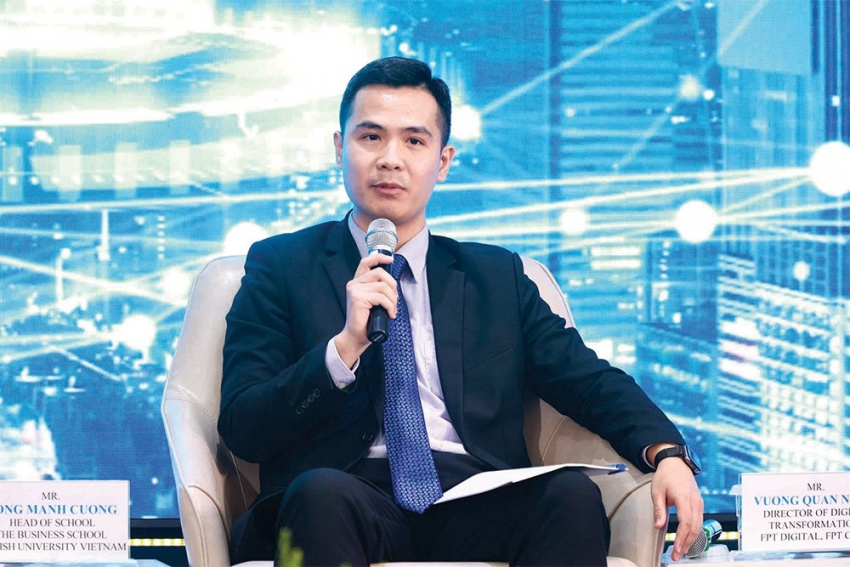 Dong Manh Cuong
In the domain of data- and AI-driven decision-making, many young workers can use tools but lack analytical thinking and the ability to design data-driven strategies. What we need are not just people who can use AI but those who can apply it to business models, those who know how to ask the right questions and understand how it affects a company’s value chain.
In data governance, the shortage of professionals with expertise in data architecture, security, compliance, and advanced analytics means many businesses find themselves drowning in data but unable to convert it into competitive advantage. The biggest gap lies in “bridge” positions: people who can translate the technical language of IT teams into the strategic language of business teams, enabling faster and more accurate decision-making.
Vietnam also faces a severe shortage of digital product managers and digital transformation leaders who can drive the full lifecycle of a product, from ideation to development, testing, optimisation, and scaling. Many companies in fintech, digital banking, e-commerce, and tech-enabled logistics still have to assign digital transformation tasks to traditional managers, even though the required capabilities lie in agile thinking, user behaviour insights, and the ability to integrate multiple data sources.
As emerging technologies such as blockchain, 5G, the Internet of Things (IoT), and digital payment systems evolve rapidly, the shortage of hybrid talent has become even more pronounced. These are people who not only understand technology but also business models, regulatory requirements, and safety standards. This group is also capable of operating blockchain-based financial models, optimising supply chains using real-time data from 5G and IoT, or developing new fintech services aligned with regulatory frameworks.
How does British University Vietnam (BUV) embed the integration of business and technology into its academic programmes, ensuring that students can translate these technologies into business strategies and innovation-driven value?
At BUV, the integration of business and technology is embedded consistently from programme design to lectures, teaching methods, and assessments. We do not teach technology as a standalone subject; we embed it within real business contexts.
In lectures on AI, data, or 5G, faculty do not start with technical principles, they begin with the business problem and identify where technology can create value. Students encounter technology through practical scenarios such as demand forecasting, digital product design, strategy planning, or operational improvement, helping them develop a mindset that views technology as a tool for economic value creation.
Our teaching methodology is designed so students learn through experience rather than just absorbing theory. In data analytics classes, students work with real corporate datasets and translate outcomes into strategic recommendations. In digital product development courses, they must create prototypes, run user tests, and defend their ideas. Faculty act as facilitators, asking critical questions and guiding students to think independently and analytically.
Assessments at BUV are primarily project-based, requiring students to apply both business thinking and technological understanding. An assessment may ask students to analyse the impact of 5G on a business model, build an AI-based forecasting model, or propose a new digital service based on customer data.
What strategic partnerships is BUV pursuing with technology firms, digital enterprises, and innovation ecosystems to enhance students’ practical business tech capabilities?
We view strategic partnerships with technology companies and innovation ecosystems as an integral part of our educational philosophy. In line with this approach, BUV is also expanding its academic offerings, including the Business Technology programme delivered in collaboration with Manchester Metropolitan University - a university with over 200 years of history in one of the UK’s key financial and technology hubs - to prepare students with the managerial insight and technological literacy needed to work effectively in organisations undergoing digital transformation.
BUV collaborates with companies in AI, data analytics, cloud computing, and cybersecurity to bring real-world cases into our curriculum and to develop consulting projects that students can contribute to. Through these partnerships, students work directly with real data and real workflows, such as building AI models for marketing, optimising operations with big data, or participating in projects that design cloud-based digital solutions.
In parallel, BUV is developing partnerships with companies in fintech, e-commerce, tech logistics, and firms deploying 5G or IoT infrastructure. These partners provide internships and also co-design lessons, deliver guest lectures, and present real business problems for students to solve. This allows students to explore emerging digital-era business models such as digital payment platforms, platform-based economies, smart supply chain management, and real-time data-driven services.
Importantly, students do not merely observe; they must analyse, propose, and test ideas, developing innovation mindsets grounded in technological application.
Beyond corporate partners, BUV also collaborates with incubators, innovation hubs, and startup ecosystems to create environments where students can prototype ideas and receive guidance from industry mentors. These ecosystems help students understand how technology is commercialised, especially in fields like AI, big data, or intelligent automation. Many student projects at BUV have been highly regarded by industry partners and selected for pilot implementation, demonstrating the real value of this collaboration model.