

INTERNATIONAL INVESTMENT
AND PORTAL
Hanoi is intensifying its crackdown on the dog and cat meat trade, aiming to wipe out human rabies deaths by 2030 as local businesses face collapsing revenues and stricter regulations.
Hanoi is accelerating its transition away from the dog and cat meat trade, linking the move to a broader public health strategy to eliminate rabies by the end of the decade. At a conference on March 24, the Hanoi Sub-department of Animal Husbandry, Aquaculture and Veterinary Medicine detailed a phased roadmap to phase out the trade while strengthening animal disease surveillance.
 The conference, themed: “Solutions For Strengthening Rabies Prevention and Control and Promoting Sustainable Economic Development through the Phased-Transition Away from Dog and Cat Meat Trade - Towards a Safe and Civilized Urban Communities” targeted government officials and veterinary staff
The city is enforcing stricter controls on the origin, slaughtering conditions, and circulation of animal products, following recent municipal directives. This shift comes as the industry faces a sharp downturn. A 2025 survey of 113 establishments across 14 wards revealed that 83 per cent of businesses reported declining revenues, with some seeing drops of up to 70 per cent.
Pressure to exit the sector is mounting from within. The data shows 67 per cent of traders do not want their children to inherit the business, and 44 per cent have considered closing down. However, the transition remains fraught with economic hurdles.
“Most businesses are willing to comply but struggle because this has been their primary income for years,” said Tran Thi Nguyet, an official from Ha Dong district. She noted that traders are concerned about access to capital for new equipment and the increased competition in alternative sectors.
 Dao Huu Than, deputy director of the Hanoi Centre for Disease Control, warns about rabies risks
Public health remains the primary driver for the policy. Dao Huu Than, deputy director of the Hanoi Centre for Disease Control, warned that rabies is a persistent threat recorded in 60 of 63 provinces over the last decade. The disease claims approximately 70 lives annually in the country, costing the healthcare system more than $41.7 million each year for vaccines and immunoglobulin treatments.
International partners are backing the initiative, emphasizing the need for a clear, sustainable roadmap for livelihoods.
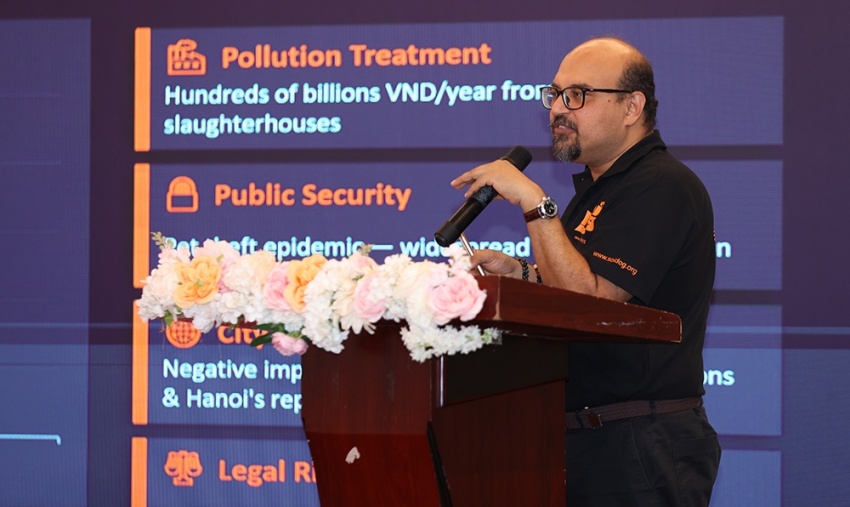 Faizan Jalil, Senior Manager at Soi Dog Foundation, responsible for behavior change communication
“Stricter control over slaughtering and trading is essential for risk prevention,” said Faizan Jalil, senior manager at Soi Dog Foundation. He added that supporting households to shift toward more sustainable vocations is vital for developing a “civilised urban environment.”
The programme will continue to expand inter-agency coordination, providing support for households to exit the trade while ensuring Hanoi reaches its goal of zero human rabies deaths by 2030.
 The Organising Committee with conference participants
By Phương Linh