
INTERNATIONAL INVESTMENT
AND PORTAL
How do you see 5G and AI technologies transforming the competitiveness of Singapore’s key sectors?
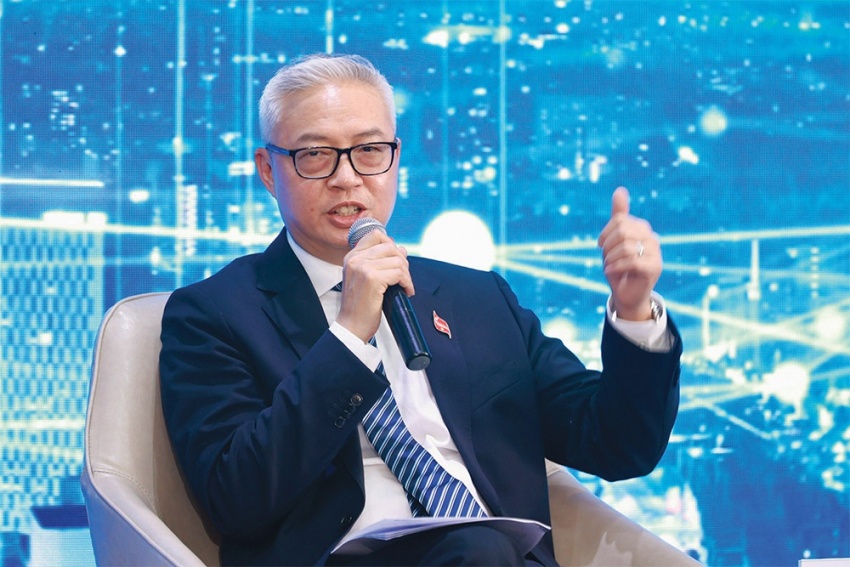 Seck Yee Chung, vice president of the Singapore Chamber of Commerce in Vietnam
The rollout of 5G and AI will have a profound impact on various industries in Singapore, including healthcare, transportation, manufacturing, and entertainment. It will enable advancements such as remote healthcare services, autonomous vehicles, smart manufacturing processes, and immersive digital experiences.
There is Singapore’s Tuas Port, where a bold vision set in 2012 is now materialising into a fully automated, AI-driven logistics hub powered by triple-band 5G. In less than three years since launching operations, Tuas has handled over 10 million TEUs with zero on-site operators, replacing manual processes with networked machines, predictive AI, and a transformed, tech-enabled workforce. It is a living model of how ASEAN can lead with vision, embrace experimentation, and unlock digital competitiveness at scale.
Elsewhere, the Hyundai Motor Group Innovation Centre Singapore leverages 5G-AI and advanced automation to revolutionise EV manufacturing. Partnering with Singtel, it employs a private 5G network for real-time data, digital twin simulations, and quality control.
Jurong Innovation District also serves as a 5G-powered smart factory testbed, deploying AI-driven robotics and Internet of Things (IoT) sensors in semiconductor manufacturing.
When it comes to healthcare and telemedicine, M1 Ltd., in collaboration with Fullerton Health, has introduced 5G-enabled telemedicine services tailored for the maritime sector. This initiative facilitates live teleconsultations between seafarers aboard vessels and shore-based healthcare professionals.
And the National University Health System has leveraged 5G technology to implement mixed reality-based holomedicine in operating theatres. This application enhances patient care by providing surgeons with augmented reality visualisations during procedures.
How can Singapore’s regulatory environment continue to encourage responsible AI innovation while encouraging rapid 5G deployment?
Singapore’s regulatory environment can continue to foster responsible AI innovation while accelerating 5G deployment by reinforcing a balanced framework of privacy protection, security assurance, and pro-innovation governance.
Firstly, regulators such as the Personal Data Protection Commission ensure that all 5G network deployments comply with stringent data protection requirements under the Personal Data Protection Act. This includes mandating that telcos and enterprises adopt strong data governance practices, ensure proper data minimisation, and use secure-by-design architectures when deploying AI-enabled 5G applications that process personal or sensitive information. Such requirements ensure that rapid innovation does not compromise individual privacy or undermine public trust.
Secondly, Singapore promotes responsible AI and safe 5G expansion by enforcing robust cybersecurity standards across network infrastructure. 5G networks must adhere to the Cybersecurity Act, which require operators to integrate advanced security protocols, such as zero-trust frameworks, end-to-end encryption, and AI-driven threat detection systems.
Thirdly, to maintain accountability and operational resilience, Singapore requires regular audits, penetration testing, and risk assessments for 5G systems and AI-driven applications. Telecommunications licensees must demonstrate compliance with IMDA’s technical codes and submit to periodic reviews that verify the integrity of critical infrastructure. This continuous monitoring ensures that emerging threats are swiftly identified and that network operators remain aligned with evolving security best practices.
What opportunities exist for regional cooperation in developing shared standards and interoperability for 5G-AI technologies?
There is ASEAN-wide 5G and AI technical standard harmonisation. Singapore can work through ASEAN platforms to develop: common 5G security baselines, shared AI governance principles (aligned with Singapore’s Model AI Governance Framework), standardised APIs, and data formats to allow cross-border digital services. This reduces fragmentation and allows regional companies to scale 5G–AI products across multiple markets.
We should have cross-border testbeds and sandboxes: leading players can partner with regional regulators to create multi-country testbeds, especially for autonomous vehicles and drones, smart port operations,remote healthcare and telemedicine using 5G, and AI analytics for cross-border logistics.
We can share such testbeds accelerate adoption and ensure technologies interoperate across networks and jurisdictions.
Meanwhile, ASEAN countries should collaborate on AI safety, cybersecurity, and network resilience. Singapore can lead regional groups to develop shared AI risk frameworks, incident response protocols for 5G networks, and joint cyber drills for telcos and critical infrastructure operators.